Care for the complete garment
Follow the item’s permanent label, treat only what needs treatment, control heat and mechanical stress, dry with structure in mind, and repair early.
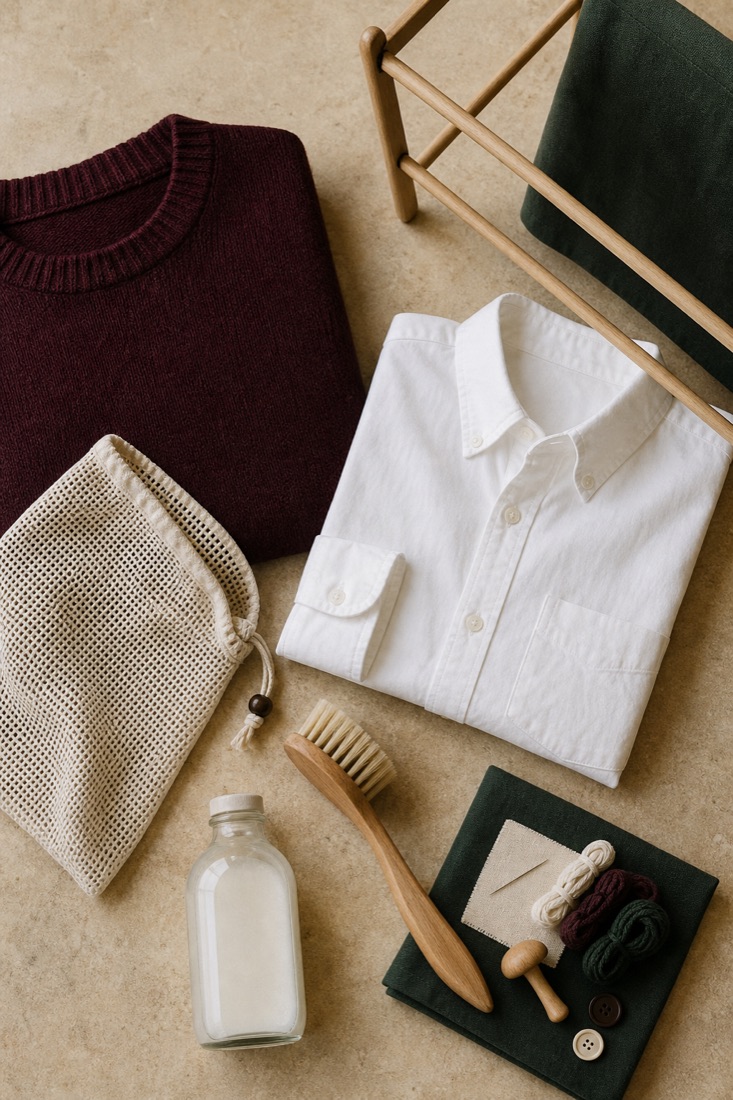
Read the permanent label before the stain
The FTC Care Labeling Rule requires covered manufacturers and importers in the United States to provide regular care instructions and relevant warnings with a reasonable basis. The guidance treats washing, bleaching, drying, ironing, and warnings as connected parts of the instruction. That matters because a garment labeled for washing may still be harmed by high heat, bleach, or ironing.
Photograph the label when text begins to fade. Record fiber content separately from care: the fiber explains some tendencies, while the instruction applies to the whole garment, including dye, finish, trim, buttons, interfacing, and lining. Do not assume that two garments with the same fiber percentage can tolerate the same method.
| Entity | Attribute | Value to read | Decision it controls |
|---|---|---|---|
| Garment | Wash method | Machine, hand, or no wash | Water and agitation route |
| Garment | Bleach warning | Allowed type or prohibition | Chemical treatment |
| Garment | Drying | Tumble setting, line, flat, or other | Heat and shape support |
| Garment | Ironing | Need, temperature, or prohibition | Heat and pressure |
| Garment | Special warning | Do not, only, wash separately | Prevents foreseeable harm |
Choose the least harmful adequate cleaning
Inspect soil, odor, and the area of contact. A small removable mark may need targeted treatment rather than a full cycle, but stain chemistry and dye stability matter. Blot instead of rubbing when rubbing could spread the stain or abrade the surface. Test any permitted product in an inconspicuous area and never mix cleaning chemicals casually.
Before a machine cycle, close suitable fasteners, empty pockets, turn vulnerable surfaces inward, and use a mesh bag for pieces that can snag or stretch. Sort by color, soil, lint behavior, and the temperature or cycle allowed by labels—not only by broad fiber category. Do not overload the machine; garments need enough movement and rinse water for the selected process.
Cleaning decision framework
- Read the full care instruction and warnings.
- Identify soil, location, age, and whether the dye or finish is uncertain.
- Select the gentlest label-compliant method likely to work.
- Test a treatment where appropriate and stop if color or surface changes.
- Inspect before heat drying, because heat can make some remaining stains harder to remove.
For fragile, antique, mold-affected, heavily embellished, or materially uncertain textiles, seek qualified conservation or cleaning advice. Smithsonian textile conservation guidance emphasizes examination, documentation, preventive care, and trained treatment; home experimentation can permanently alter a valuable object.
Dry and finish according to structure
Water adds weight. A wet knit may stretch when hung, while a structured woven may need reshaping along seams. Follow the label’s drying method, remove items at the appropriate time, and avoid heat beyond the instruction. Smooth seams, collars, cuffs, and hems before drying when the method allows. Lay items flat on a supportive, ventilated surface when flat drying is specified.
Ironing combines heat, pressure, moisture, and time. Use the permitted setting, test the wrong side where prudent, protect surfaces with a clean pressing cloth when appropriate, and lift rather than drag on shapes that can distort. Steam is not universally safe merely because it feels gentle; finishes, dyes, adhesives, and some fibers can react.
Method and warnings
Only needed soil
Control heat and shape
Store only clean and dry
Store clean, dry, supported, and observable
Storage should protect from light, dust, moisture, pests, abrasion, and distortion. Use shaped hangers for garments whose shoulders and weight tolerate hanging; fold heavy or stretch-prone knits with minimal hard creasing. Do not crowd clothes so tightly that ventilation and inspection become difficult.
Smithsonian guidance for museum textiles discusses protective coverings, environmental stability, pest awareness, and appropriate archival materials. Everyday clothing does not require museum storage, but the principles translate: avoid prolonged direct sunlight, damp enclosed spaces, dirty shelves, and unknown material contact that transfers color or abrasion. Inspect seasonal storage rather than sealing and forgetting it.
Create a small repair loop
Loose buttons, opening seams, fallen hems, small snags, and worn heel or cuff areas become larger when ignored. Keep a repair basket with a date and schedule a short monthly review. Match the repair method to construction; do not cut a pulled knit thread without understanding where it leads.
| Finding | Immediate action | Next decision | Escalate when |
|---|---|---|---|
| Loose button | Stop wearing under strain | Reattach with matching support | Fabric is tearing at attachment |
| Opening seam | Prevent further pulling | Restitch along original seam | Seam allowance is frayed or lined |
| Small stain | Blot and identify | Use label-compliant treatment | Dye, finish, or valuable fabric is uncertain |
| Shape distortion | Remove stress | Assess wet-blocking or professional help | Structure or interfacing is affected |
Care burden belongs in the purchase decision. If the realistic routine is incompatible with your week, the capsule plan should treat that as a constraint rather than a moral failure.
Sources and further reading
These references support the standards and factual claims in this guide. The decision frameworks and worked examples are original editorial synthesis.
Questions practitioners ask
Can a general fiber guide override a care label?
No. The care label applies to the complete garment, including dyes, trim, lining, finishes, and construction. General fiber information helps explain risk but is not a substitute.
Does dry clean mean dry clean only?
Read the exact wording on the item. The FTC distinguishes required instructions and warnings; do not infer an alternative procedure that the complete garment has not been shown to tolerate.
Should clothes be washed after every wear?
Not universally. Hygiene, soil, skin contact, activity, material, and garment type differ. Inspect and air suitable items, but follow the label and clean promptly when needed.